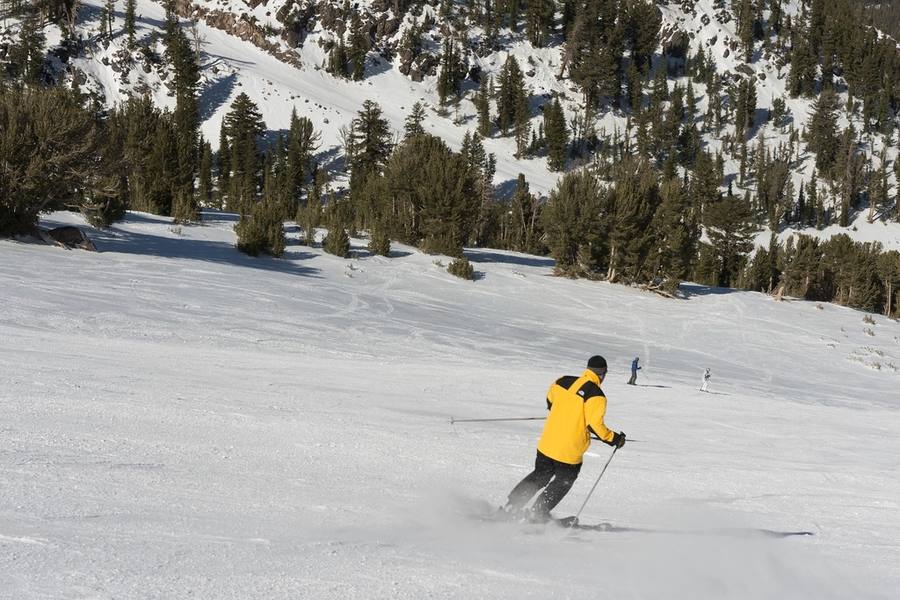
Representative image (stock photo); not the exact product.
Length Sets The Plant
Pole length determines where a pole plant falls relative to the body, and a pole too long forces an upright stance while one too short pulls the skier forward.
The standard check is holding the pole upside down under the basket with the elbow at ninety degrees, which gives a usable starting length.
Adjustable poles cover the range and are heavier with a joint that can slip, which is why fixed poles remain standard for resort skiing.
Straps Break Thumbs
Skier's thumb — a tear of the ligament at the base of the thumb — is one of the most common skiing injuries and is caused by falling with a hand through a pole strap.
Releasable strap systems let the pole go in a fall, and plain straps do not, which is a genuine and well-documented difference in injury outcomes.
Skiing without straps entirely, or through gladed terrain where a pole can snag, is a reasonable choice and costs only the occasional dropped pole.
Baskets And Snow Conditions
Small baskets suit firm groomed snow where a pole does not sink, and they disappear into soft snow entirely and give no support.
Powder baskets are considerably larger and keep the pole on the surface, which matters for balance in deep snow and for touring.
Baskets are cheap and swap in seconds, and carrying a set of powder baskets costs almost nothing.
Aluminium Against Carbon
Aluminium bends under load and can frequently be bent back, and carbon is lighter and stiffer and snaps without warning when it fails.
For resort skiing, where poles are dropped, run over and caught in lift machinery, aluminium is the pragmatic choice.
Carbon is worth the weight saving for touring, where poles are carried and planted thousands of times a day.
Grips, Gloves And Cold Hands
A grip sized for a bare hand is tight over a thick glove, and a grip too large cannot be held securely with a thin one.
Extended grips running down the shaft let a pole be held lower on a traverse or a steep section without adjusting length.
Cold hands are the commonest complaint on a ski day and are affected by grip material, since metal and hard plastic conduct heat away from the hand faster than foam or rubber.
Losing poles on a chairlift is common enough to be worth a habit rather than an accident, since poles dropped from height are rarely recovered and a run without them is unpleasant. Holding both poles in the outside hand while loading, and not looping straps around a wrist on a lift, prevents nearly all of it. Some skiers clip poles together, which makes them harder to drop individually.
Tip design affects grip on ice, and a carbide tip bites where a worn steel one skates across hard refrozen snow without holding.
Colour visibility is a small practical point, since a pole dropped in deep snow is far easier to find in orange than in black or white.
The Verdict
A cheap and simple item where strap design has a genuine effect on a common injury.
Straps cause thumb ligament tears, small baskets vanish in deep snow, and carbon snaps without warning.
Use releasable straps or none. Skier's thumb comes from falling with a hand through a fixed strap.
At a glance
Pros
- Cheap, durable and easily replaced
- Aluminium bends rather than snapping
- Baskets swap in seconds for conditions
- Releasable straps reduce a common injury
Cons
- Fixed straps cause thumb ligament tears
- Small baskets give no support in soft snow
- Heavier than carbon for touring
- Grip size rarely suits every glove thickness
Frequently asked questions
What length should my poles be?
Hold the pole upside down and grip it under the basket — your elbow should sit at about ninety degrees. Too long forces you upright, too short pulls you forward, and both affect your stance more than people expect.
Should I use the straps?
Releasable ones, or none. Skier's thumb — a ligament tear at the base of the thumb — is among the most common skiing injuries and comes from falling with a hand through a fixed strap. Going without costs only the occasional dropped pole.
Do I need powder baskets?
If you ski soft snow, yes. Small piste baskets disappear into deep snow and give no support at all. They swap in seconds and cost almost nothing, so carrying a set is straightforward.
Specifications
| Type | Fixed length aluminium ski poles |
| Length check | Elbow at 90 degrees, pole inverted |
| Injury risk | Skier's thumb from fixed straps |
| Safer | Releasable straps, or none at all |
| Piste baskets | Small; useless in deep snow |
| Powder baskets | Large; cheap to carry spare |
| Aluminium | Bends and can be bent back |
| Carbon | Lighter; snaps without warning |
The bottom line
Cheap and simple. Use releasable straps — fixed ones are how skiers tear thumb ligaments.
Check Price on Amazon